
ALCID
Why ALCID?
ALCID stands for Algae, Climate, Invasive species and Diversity
As the title above suggests, this project is focusing on algae and, more specifically, macroalgae, in other words multicellular algae visible to the naked eye.
Sometimes (wrongly!) considered undesirable when they wash up on beaches, especially during green tides, seaweed actually has much more to offer us than we think. In fact, you very likely have products containing compounds derived from seaweed in your bathroom, kitchen or medicine cabinet.
Alginates, carrageenans and agar-agar may not be familiar words to you, but they are polysaccharides extracted from algae and widely used as texturing agents (thickeners, gelling agents or stabilisers). Alginates, primarily derived from brown seaweed, represent a significant portion of production and are used in the food industry, as well as in the textile, cosmetic, pharmaceutical and medical sectors (for example, in dressings and dental impressions). Carrageenans and agar-agar, extracted from red seaweed, are mainly used in the food industry for their gelling properties. These compounds are found in many everyday products: yoghurts, desserts, jams, deli meats and sweets. On labels, they are generally listed as additives between E400 and E407.
Seaweed has also long been used in agriculture, particularly in coastal regions. Seaweed collected from the foreshore is high in minerals and can be spread on soil to improve fertility and water retention capacities. Seaweed extracts are also used as biostimulants to promote plant growth. Furthermore, certain types of seaweed can be used as nutritional supplements in animal feed.
However, macroalgae are not only useful to our activities, but also play a major ecological role. Through photosynthesis, they capture carbon dioxide (CO₂) dissolved in the sea and produce oxygen. Through this they participate in coastal biogeochemical cycles and contribute locally to mitigating ocean acidification. They are also essential habitats for numerous marine species.
The seaweeds responsible for green tides thrive by absorbing excess nutrients, particularly nitrogen from human activities such as agriculture. They act as nutrient ‘pumps’, capturing these compounds dissolved in the water. However, this mass proliferation does not solve the problem but is a direct consequence. When these algae accumulate and decompose, they can disrupt ecosystems by consuming oxygen and releasing potentially toxic compounds, thereby exacerbating environmental imbalances.
We speak of seaweed forests or beds when several species coexist in the same habitat. These assemblages are structured in different layers: some algae remain close to the substrate, while others, sometimes several metres long, form a canopy at the surface, occasionally supported by floats known as pneumatocysts. These three-dimensional structures constitute genuine ecosystems, offering refuge, food and breeding grounds to a wide diversity of organisms ranging from microorganisms to fish, crustaceans and marine mammals. At low tide, they also allow many species to mitigate the stress linked to desiccation and predation.
Given all these roles, it is essential to better understand these organisms and anticipate the effects of environmental changes on how they function. Climate change, in particular changing water temperatures, influences their growth, reproduction and distribution. This leads to shifts in distribution ranges, with some species declining in warmer regions and expanding in more northerly areas.
Furthermore, macroalgae also face the introduction of invasive alien species. On the French coast, for example, Sargassum muticum, a seaweed native to Asia, has been accidentally introduced, particularly through the transport of oysters. This species can compete with local algae and alter ecosystems, although its impacts are still being studied.
Given this context, the ALCID project is aiming to study how macroalgae communities, particularly in Brittany and in the presence of invasive species, react to ongoing environmental changes.
ALCID's scientific approach
Seaweed beds are an essential resource for the functioning of coastal ecosystems. Many human activities, such as fishing and the agri-food, medical and cosmetic sectors, depend on the health of these seaweed beds.
Global change is affecting the temperature of the waters off our coasts, and invasive species are colonising these environments.
As a result, local macroalgae tends to disappear in favour of new invasive species.
Local species could be affected by the presence of invasive species and rising temperatures.
Their biological rhythms, defence mechanisms and synthesised compounds could be altered.
Scientists are therefore pondering whether climate change could affect local and invasive seaweed beds.
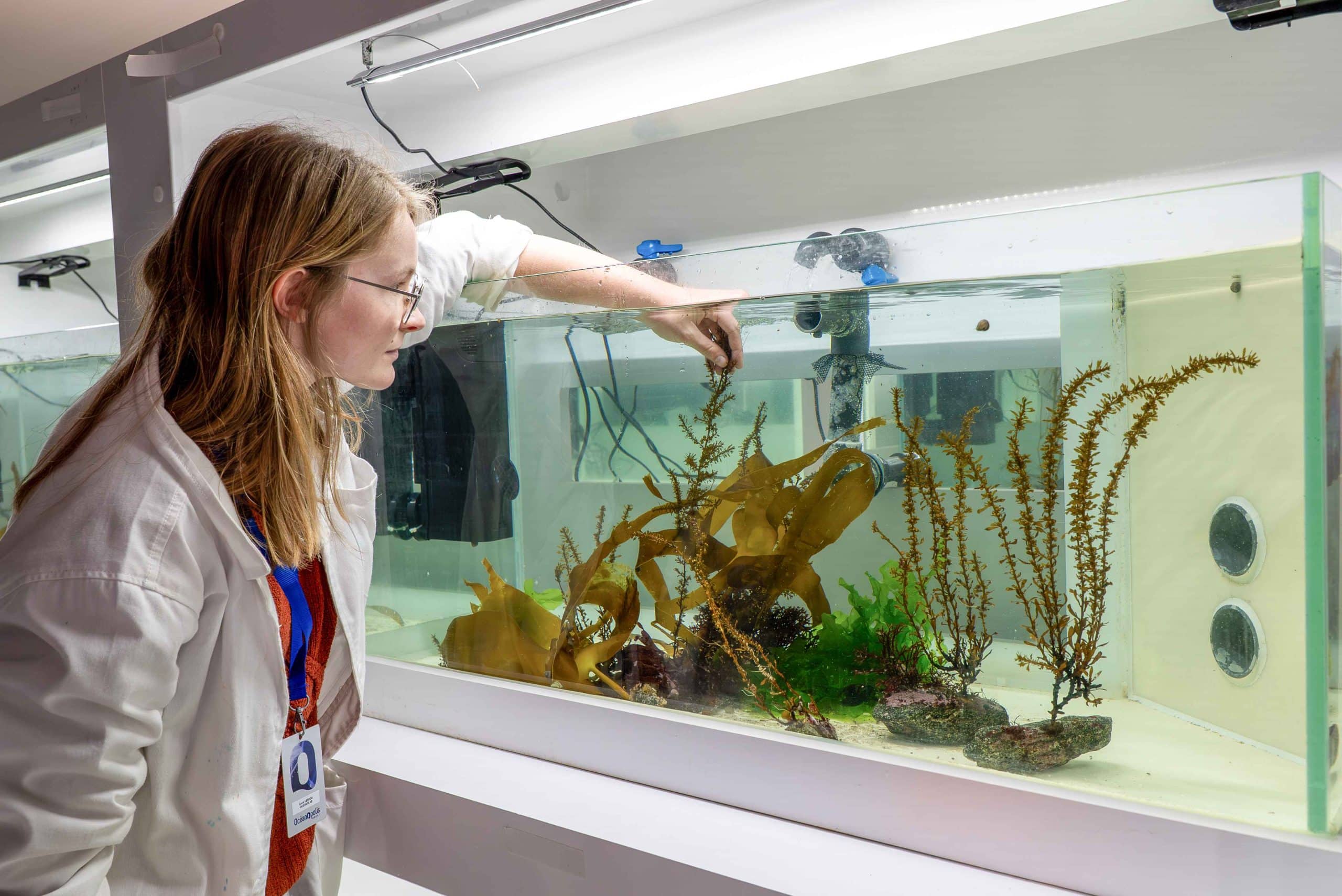
To address these issues, the research team will rely on a scientific experiment of approximately seven months to study seaweed beds reconstituted in the laboratory under different conditions.
Condition 1: Native seaweed bed and current climate -> The seaweed bed is composed of local canopy species, namely Himanthallia elongata and Laminaria digitata. The temperature remains representative of the northern Finistère coast and varies according to the season.
Condition 2: Native seaweed bed and future climate -> The seaweed bed is composed of local canopy species, namely Himanthallia elongata and Laminaria digitata. The aquarium temperature is increased by 2°C (IPCC scenario) to represent the climate of the northern Finistère coast in 100 years. As with the previous condition, temperature will vary according to the season.
Condition 3: Invasive and warmer-tolerant seaweed bed and current climate -> The seaweed bed is composed of an invasive exotic species, Sargassum muticum (Japanese wireweed), and Laminaria ochroleuca (golden kelp), a species more commonly found in the waters of southern Finistère. The temperature remains representative of the northern Finistère coast and varies according to the season.
Condition 4: Invasive and warmer-tolerant seaweed bed and future climate -> The seaweed bed is composed of an invasive exotic species, Sargassum muticum (Japanese wireweed), and Laminaria ochroleuca (golden kelp), a species more commonly found in the waters of southern Finistère. The aquarium temperature is increased by 2°C (IPCC scenario) to represent the climate of the northern Finistère coast in 100 years. As with the previous condition, temperature will vary according to the season.
In addition to these canopy-forming species, there are shorter seaweeds such as sea lettuce, Irish moss and dulse.
Throughout the seven months, scientists will monitor various parameters of seaweed health, including photosynthetic efficiency, the chemical compounds they produce and their reproductive cycles. In addition, the diversity of species living in the beds will also be studied.
Not so fast! Scientists first need to analyse their results!